Cardiovascular System
The three main divisions of the circulatory system are:
- The Heart
- The heart consists of 2 muscular pumps known as the left and right ventricles. The ventricles have 2 reservoirs called atria (left and right). Each ventricle acts to serve different circulations. The right ventricle shifts deoxygenated blood into the pulmonary circulation. Blood enters the network of capillaries in the lungs and through a process of diffusion carbon dioxide is lost and oxygen is aquired; it then returns to the left atrium. The left ventricle is the pump responsible for delivering blood into the systemic circulation where it carries nutrients and oxygen to the tissues. An exchange of nutrients and oxygen for carbon dioxide and waste takes place; the waste rich blood now returns to the right atrium.
- Blood Vessels
- are intricate networks of hollow tubes that
transport blood throughout the entire body.
- Arteries:
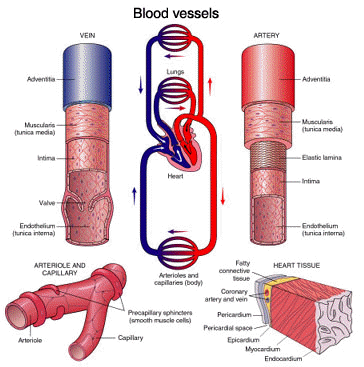
- These blood vessels transport blood away from the heart. Arteries are thick, muscular walled structures compared to veins as they are designed to accommodate the high flow and pressures exerted by the force delivered by the heart. In larger arteries, e.g.Aorta, more elastic tissue is contained within the tunica media but has less smooth muscle.
- Arterioles:
- Smaller diameter blood vessels with thin muscular walls that extend and branch out from an artery and leads to capillaries. These vessels are the primary site of vascular resistance.
- Capillaries:
- Smallest of a bodies blood vessels, measuring just 5-10 μm in diameter. Capillaries connect arterioles and venules. The walls of the capillaries are only one cell thick which enables the interchange of water, oxygen, carbon dioxide, nutrients and waste products from the blood and surrounding tissues.
- Venules:
- A small blood vessel that drains deoxygenated blood from the capillary beds to return to the larger blood vessels called veins. Many venules join to form a vein.
- Veins:
- These vessels transport blood towards the heart. The majority of veins carry de-oxygenated blood except for the pulmonary vein which carries oxygen rich blood from the lungs back to the left atrium.
- Arteries:
- Epicardium: the outer layer of heart tissue
- Myocardium: or Cardiac muscle (heart muscle) is a type of involuntary striated muscle found in the walls and it's responsible for the pumping action of the heart
- Endocardium: the innermost layer of tissue that lines the chambers of the heart
- Outermost - Fibrous Pericardium
-
Inner - Serous Pericardium
- Tricuspid Valve: located between the right atrium and the right ventricle and regulates blood flow at this point.
- Semi-Lunar Pulmonary Valve: located between the right ventricle and the pulmonary trunk and is responsible for blood flow to the lungs.
- Mitral Valve: located between the left atrium and the left ventricle and lets Oxygen rich blood from the lungs pass from the atia into the left ventricle
- Semi-Lunar Aortic Valve: located at the exit of the aorta and the left ventricle where the oxygen rich blood is delivered to the rest of the body
- Tunica Adventitia: The tunica adventitia is the strong outer covering of arteries and veins. It is composed of connective tissue as well as collagen and elastic fibres. These fibres allow the arteries and veins to stretch to prevent overexpansion due to the pressure that is exerted on the walls by blood flow.
- Tunica Media: The tunica media is the middle layer of the walls of arteries and veins. It is composed of smooth muscle and elastic fibres. This layer is thicker in arteries than in veins
- Tunica Intima: The tunica intima is the inner layer of arteries and veins. In arteries this layer is composed of an elastic membrane lining and smooth endothelium that is covered by elastic tissues.
-
Veins do not contain the elastic membrane lining that is found in arteries. In some veins the tunica intima layer also contains valves
Heart structure and function.
The heart is a sort of upside down cone shape with blunted edges. On the outside there is a layer of fat, and across its surface are a network of veins and arteries, known as the coronary vessels, which keep the muscle supplied with blood.
The heart's job is to pump blood around the body to where it is needed. Consequently, the heart is made up of cardiac muscle, which can contract often without tiring.
The wall of the heart consists of 3 layers:
Pericardium: The heart is surrounded by the pericardium, a tough double layered membrane which covers the heart. The 2 layers are known as:
The space between the 2 layers is filled with a pericardium fluid which acts as a lubricant
Heart Chambers: There are 4 chambers in the heart. There are 2 upper ones called the Atria and 2 lower ones called the ventricles. Between the left and right sides of the heart lies the septum.
Atria Structure: The right atrium contains the sinoatrial node which sends an impulse throughout the heart causing the cardiac muscle of the atrium to contract in a coordinated, wave-like manner. Since the atria are thin-walled and much less muscular than the ventricles, they are able to easily expand with the addition of blood. The forces of contraction are much weaker within the atria as a result. The contraction is strong enough, however to force 1/4 of the total blood volume entering into the ventricles. The rest of the blood enters the atria passively. Heart Chamber
Ventricle Structure: The two ventricles are separated by a septum into the left ventricle and the right ventricle. The ventricles of the heart are muscular chambers because they are responsible for propelling blood out of the heart. The left ventricle is the thickest of the four chambers because it is the final chamber that oxygenated blood must be pumped through before it is distributed throughout the body via the circulatory system. The ventricles are also larger in size compared to the atria. Heart Chamber
The Heart valves open to allow the blood to flow in the right direction into, within, or out of the heart, and close to prevent the backflow of blood:
Structure of Vessels:
The vessel wall consists of three layers:
Blood
- Blood consists of many components (constituents). These
include:
- 55% Plasma
- 45% Components, i.e. 'Blood Cells'. Of these, 99% are erythrocytes (red blood cells) and 1% are leucocytes (white blood cells) and thrombocytes (blood platelets).
Functions of Blood
1 Transports:
- Dissolved gases (e.g. oxygen, carbon dioxide)
- Waste products of metabolism (e.g. water, urea)
- Hormones
- Enzymes
- Nutrients (such as glucose, amino acids, micro-nutrients (vitamins & minerals), fatty acids, glycerol)
- Plasma proteins (associated with defence, such as blood-clotting and anti-bodies)
- Blood cells (incl. white blood cells 'leucocytes', and red blood cells 'erythrocytes')
2 Maintains Body Temperature
3 Controls pH
- The pH of blood must remain in the range 6.8 to 7.4, otherwise it begins to damage cells.
4 Removes toxins from the body
- The kidneys filter all of the blood in the body (approx. 8 pints), 36 times every 24 hours. Toxins removed from the blood by the kidneys leave the body in the urine. (Toxins also leave the body in the form of sweat.)
5 Regulation of Body Fluid Electrolytes
- Excess salt is removed from the body in urine, which may contain around 10g salt per day (such as in the cases of people on western diets containing more salt than the body requires)
Clotting Process
Within 20 seconds of an injury to a blood vessel the process of sealing this injury site begins. This process is termed coagulation. The stages of coagulation are as follows:
-
The blood vessel releases an enzyme called thrombokinase
-
The released thrombokinase starts the conversion of an inactive enzyme prothrombin into thrombin
-
Thrombin initiates a reaction to convert a another protein fibrinogen, which is present in plasma, to fibrin.
-
Fibrin in turn forms a type of net over the injury site which then captures red blood cells and creates a seal. The clot then dries forming what we know as a scab
Circulatory Problems
Peripheral artery disease:
Peripheral artery disease (PAD) is a condition where fatty deposits build up in the inner linings of the artery walls. The narrowing restricts blood circulation, mainly in arteries leading to the kidneys, stomach, arms, legs and feet. Early symptoms are cramping, fatigue or numbness in the legs and buttocks that occurs during moderate exercise or simple walking. The cramping usually stops as and when the person stands still. This is called "claudication." Those with the fatty deposits also run a higher risk of developing a stroke or a myocardial infarct, this can lead to death. People at risk of PAD are those that have Diabetes, Hypertension, High Cholesterol and smokers.
Treatment for these patients include the following:
-
Diabetic control
-
Low cholesterol diet
-
Blood pressure medication
-
Angioplasty to widen the narrowed arteries
-
In severe cases the patient may have to under go a bypass operation so blood can pass freely to the affected part